1. Introduzione
This manual provides detailed instructions for the installation, operation, and maintenance of the Supermicro MBD-X10SLH-F-O uATX Server Motherboard. Please read this manual thoroughly before beginning installation to ensure proper setup and to maximize the performance and longevity of your system. This motherboard is designed for server applications, supporting Intel LGA1150 processors and DDR3 memory.
2. Produttu Finituview
The Supermicro MBD-X10SLH-F-O is a high-performance uATX server motherboard featuring the Intel C226 chipset. It is engineered for reliability and efficiency in server environments.
Funzioni chjave:
- Presa CPU: LGA1150, supporting Intel Xeon E3-1200 v3/v4 series, 4th/5th Gen Core i3, Pentium, Celeron processors.
- Memoria: 4x 204-pin DDR3-1600 SODIMM slots, supporting up to 32GB ECC/non-ECC Unbuffered memory.
- Slot di espansione: 1x PCI-Express 3.0 x16, 1x PCI-Express 2.0 x8, 1x PCI-Express 2.0 x4.
- Conservazione: 6x SATA3 (6Gbps) ports.
- Connettività: Dual Gigabit Ethernet LAN ports (2x RJ45) and 1x Dedicated IPMI LAN port (RJ45).
- Porti USB: 4x USB 3.0 ports, 6x USB 2.0 ports.
- Output Video: 1x VGA port.
- Fattore di forma: uATX (9.6" x 9.6").
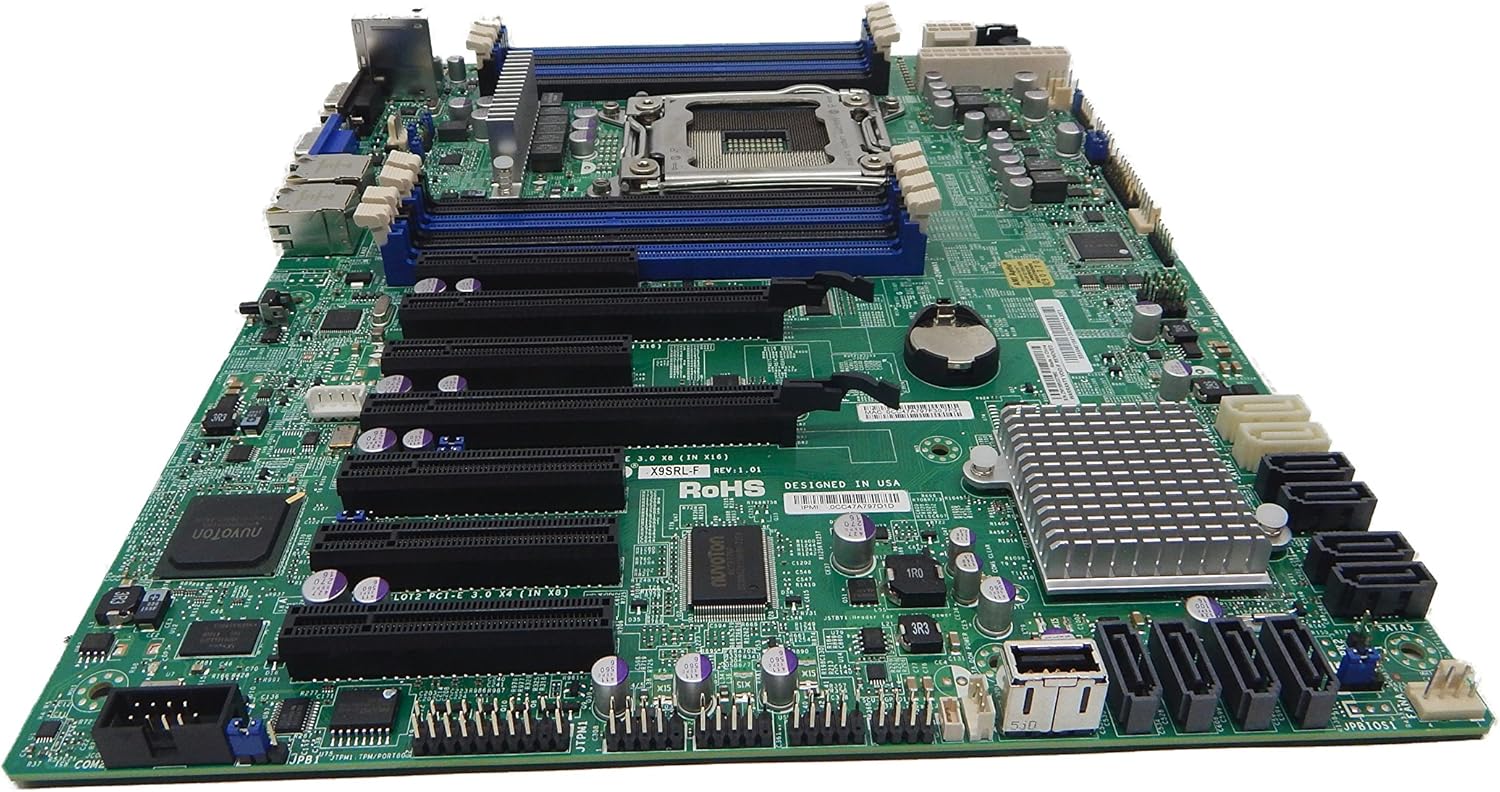
Figura 2.1: Top-down view of the Supermicro MBD-X10SLH-F-O motherboard, showing the CPU socket, RAM slots, and various expansion slots.

Figura 2.2: Angulu view of the motherboard, highlighting the LGA1150 CPU socket and the four DDR3 SODIMM memory slots.

Figura 2.3: daretu view of the Supermicro MBD-X10SLH-F-O motherboard, displaying the I/O panel with USB, VGA, LAN, and IPMI ports.

Figura 2.4: Primu pianu view of the motherboard, showing the six SATA3 ports and other onboard connectors.
3. Specificazioni
| Feature | Specificazione |
|---|---|
| Marca | Supermicro |
| Nome di mudellu | MBD-X10SLH-F-O |
| Socket CPU | LGA 1150 |
| Tipu di chipset | Intel C226 |
| Processori cumpatibili | Intel Core i3-4xxx, i5-4xxx, i7-4xxx, i3-5xxx, i5-5xxx, i7-5xxx, Intel Xeon E3-1200 v3/v4 series |
| Tecnulugia di memoria RAM | DDR3 |
| Velocità di memoria | 1600 MHz |
| RAM massima supportata | 32 GB |
| Numero di porti USB 2.0 | 6 |
| Numero di porti USB 3.0 | 4 |
| Porti SATA | 6x SATA3 (6Gbps) |
| Slots di espansione | 1x PCIe 3.0 x16, 1x PCIe 2.0 x8, 1x PCIe 2.0 x4 |
| Fattore di forma | uATX |
| Dimensioni (LxPxH) | 14 x 11 x 3.5 inch |
| Pesu di l'articulu | 3.52 once |
4. Setup
Before beginning installation, ensure your system is powered off and disconnected from the power source. Always handle the motherboard by its edges to avoid static discharge.
4.1. Installazione di a CPU
- Gently lift the CPU socket lever.
- Align the CPU with the socket, ensuring the gold triangle on the CPU matches the triangle on the socket.
- Pone cù cura a CPU in u socket senza furzà la.
- Lower the socket lever and secure it.
- Applicate a pasta termica è installate u raffreddatore di CPU secondu l'istruzzioni di u fabricatore.
4.2. Memory Installation
- Aprite i clips à e duie estremità di u slot DIMM.
- Allineate a tacca di u modulu di memoria cù a chjave in u slot DIMM.
- Appughjà fermamente nantu à e duie estremità di u modulu di memoria finu à chì i clips si scattanu in u so postu.
4.3. Installazione di a carta d'espansione
- Remove the corresponding slot cover from your chassis.
- Allineate a carta d'espansione cù u slot PCIe desideratu.
- Press down firmly until the card is fully seated.
- Secure the card with a screw or retention clip.
4.4. Storage Device Connection
- Cunnette una estremità di un cavu di dati SATA à un portu SATA di a scheda madre.
- Cunnette l'altra estremità di u cavu di dati SATA à u vostru dispositivu di almacenamentu (HDD / SSD).
- Cunnette un cavu di alimentazione SATA da u vostru alimentatore à u dispusitivu di almacenamentu.
4.5. Cunnessioni di Potenza
- Cunnette u connettore di alimentazione principale ATX à 24 pin da u vostru alimentatore à a scheda madre.
- Cunnette u connettore di alimentazione CPU ATX 12V à 8 pin (o 4 pin) à a scheda madre.
4.6. Cunnessione di u pannellu frontale
Connect the front panel headers (Power LED, HDD LED, Power Switch, Reset Switch, USB, Audio) to the corresponding pins on the motherboard. Refer to the motherboard's silkscreen labels for correct pin orientation.
5. Operating Instructions
5.1. Avvio iniziale
- After all components are installed and connected, connect the power cord to your power supply and turn on the power switch.
- Press the power button on your chassis.
- U sistema duveria accende si, è duveria vede una visualizazione nant'à u vostru monitor.
5.2. Accessu à u BIOS/UEFI
To enter the BIOS/UEFI setup utility, press the designated key (commonly DEL or F2) during the initial boot sequence. The exact key may vary; observe the on-screen prompts.
5.3. IPMI Remote Management
This motherboard features a dedicated IPMI LAN port for remote management. To access the IPMI interface, connect the IPMI LAN port to your network. Obtain the IP address assigned to the IPMI interface (either from BIOS or a network scan) and access it via a web browser from another computer on the same network. Java may be required for remote console functionality.
6. Mantenimentu
Regular maintenance helps ensure the stability and longevity of your motherboard and system.
- Rimozione di polvere: Pulite periodicamente a polvera da a scheda madre è da i cumpunenti cù aria compressa. Assicuratevi chì u sistema sia spento è scollegatu prima di pulisce.
- Gestione di Cable: Ensure all cables are neatly routed and secured to prevent obstruction of airflow and accidental disconnections.
- Aghjurnamenti di u BIOS/Firmware: Verificate u Supermicro website for the latest BIOS and IPMI firmware updates. Follow the provided instructions carefully. Note that IPMI BIOS upgrades may require a separate license. Always update BIOS before IPMI firmware.
- Verifiche di i cumpunenti: Occasionally inspect all connections (power, data, expansion cards) to ensure they are securely seated.
7. Risoluzione di prublemi
Questa sezione tratta di prublemi cumuni chì pudete scuntrà.
7.1. System Fails to Boot
- Verificate i cunnessione di putenza: Ensure the 24-pin ATX and 8-pin CPU power connectors are securely attached.
- Riposizionà i cumpunenti: Remove and re-install the CPU, memory modules, and any expansion cards to ensure they are properly seated.
- Clear CMOS: Refer to your motherboard's detailed manual for instructions on how to clear the CMOS, which can resolve boot issues caused by incorrect BIOS settings.
- Configurazione minima: Try booting with only essential components (CPU, one RAM stick, power supply, and display) to isolate the problem.
7.2. Fan Speed Issues
Some low RPM, high-efficiency fans may not be accurately detected by the motherboard's fan controller, leading to erratic fan speed behavior (e.g., fans spinning up to max RPM). This is often due to the controller expecting server-grade fans with higher RPM ranges.
- Impostazioni BIOS: Check BIOS settings for fan control options. Adjust fan curves or modes if available.
- 3-Pin vs. 4-Pin Fans: If using 4-pin PWM fans that exhibit this behavior, consider using 3-pin adapters if available with your fans. This can sometimes provide a more stable, albeit less precise, fan control.
- IPMI Fan Control: While IPMI offers fan control, it may have limitations for low RPM fans.
7.3. SATA Port Obstruction
When installing a full-size graphics processing unit (GPU), some SATA ports may become physically blocked or difficult to access.
- Pianu avanti: Connect SATA cables to the necessary ports before installing large expansion cards.
- Angled SATA Cables: Use SATA cables with angled connectors if straight connectors are obstructed.
- Alternative Ports: Utilize any unblocked SATA ports first.
8. Infurmazioni nantu à a garanzia è l'assistenza
For detailed warranty information, including terms, conditions, and duration, please refer to the official Supermicro website or the warranty card included with your product. For technical support, driver downloads, and additional documentation, visit the Supermicro support portal.
Supermicro Official Websitu: www.supermicro.com


